

In yesterday’s 9th bargaining session, we reached one tentative agreement but spent the majority of our time discussing the same handful of proposals we’ve been focusing on for the last few sessions – and hearing the same excuses about why we’re still waiting for responses on some of SDEA members’ most widely and urgently felt issues.

We finally reached a tentative agreement on Reduced Workload Plans. This means that more educators in our bargaining unit are eligible for this program, which allows certificated staff who are nearing retirement to work less than full time in the years before retirement while getting full-time pension credit and fully paid family health benefits. With this agreement, educators who are part of the CalPERS pension program are also eligible – mostly those who started in classified roles. Read the full Tentative Agreement on Article 31: Reduced Workload Plan.

The District presented a counterproposal on Article 33: Discipline. Unfortunately, the language they proposed is still unworkable for educators, so we will need to continue discussing how to strengthen this article to give educators the professional respect they deserve, particularly when it comes to clarifying verbal vs. written warnings and how these are stored in members’ personnel files. Read all of the District’s proposed changes to Article 33: Discipline.

At this point in bargaining we’re continuing to go back and forth on the details of each proposal, so both bargaining teams shared counterproposals on articles we’ve been discussing for several sessions.
The District submitted counterproposals on the two related articles on Evaluations, bringing us closer to agreement on how to incorporate a clearer and more fair evaluation process in our next contract:
SDEA submitted counterproposals on:
- Article 5: Employee Organizational Rights, proposing scheduling New Hire Orientations that respect educator prep time at the beginning of the school year.
- Article 17: Summer School/Intersession Hours & Conditions of Employment, still advocating for a fairer system for Summer School hiring.
- Article 36: Community Schools, bringing us closer to agreement as we iron out details for Community Schools Site Coaches.
Delayed Conversations:
While we’ve made small steps toward solidifying our next contract and have come to agreement on some small pieces, the District has still not even responded to any of our proposals with a significant price tag, including proposals which critically impact educators across the District. In our first two sessions back in February and March of 2025, we proposed language to improve wages, address the crisis of Special Education staffing, end Fall excessing, and expand mental health supports. The District has yet to submit a single counterproposal on any of those articles. In the case of Special Education staffing, the District isn’t just stalling on discussing solutions – they’re violating our existing contract and have been for years. For a District that brags about supporting educators and being a “gold standard” for bargaining with us, things feel less than golden… not at the bargaining table, and certainly not in our schools and classrooms where our students don’t have what they need and deserve.
What’s Next?
Our next bargaining session is on December 18, just before Winter break. The day before, the SDEA board will review strike vote results and decide whether to set a strike date in February.
It’s important to be clear about what this strike vote is for. SDEA members are voting on whether to authorize a 1-day Unfair Labor Practice (ULP) strike over the District’s ongoing violations of our current contract, specifically around Special Education staffing. A ULP strike is not the same as an open-ended economic strike like we are seeing from other union educators across California. Economic strikes happen only when bargaining reaches impasse and breaks down. That’s not where we are. We are making progress at the table… far slower than we want, and certainly not at a “gold standard” pace, but progress nonetheless.
Our ULP strike vote is about holding the District accountable for the contract we already have, and about showing our unity in defending our students’ right to fully staffed schools. And if SDEA members authorize a 1-day ULP strike, it sends a clear message: SDEA educators are prepared to take action!
Across California, other unions do point to San Diego as an example of investment in educators. That’s because for decades SDEA members have used their collective power to hold leadership accountable. It is our solidarity that is the real gold standard. Every action we take, from wearing SDEA shirts to standing on a picket line, shows that we are united and ready to fight for ourselves and our students. We Can’t Wait!
Stay engaged:
Attend your union meetings, and if you haven’t already, vote on our potential 1-day Unfair Labor Practice strike. (Learn more here about why SDEA’s Representatives are recommending a YES vote.)
Stay informed:
Use our tracker to see all proposals exchanged so far, all tentative agreements reached, and a legend to understand what all the formatting means!
In Solidarity,
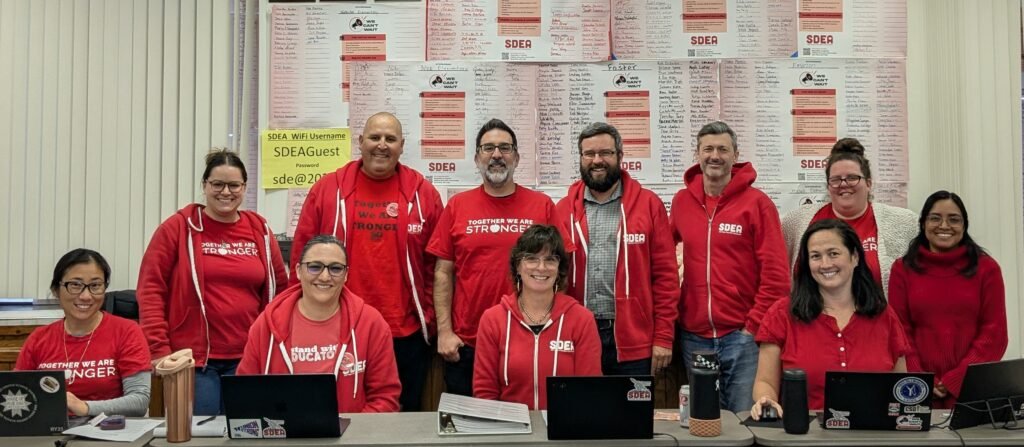
SDEA’s Bargaining Team
Kyle Weinberg, SDEA President, Ed. Specialist: Mild/Moderate, English and History Teacher; Laurie Bailon, Restorative Justice Teacher, Bell MS; Carly Bresee, Ed. Specialist: Moderate/Severe, Lafayette ES, Sarah Darr, SDEA Secretary, WCW Campaign Organizer & SLP; Christina Gallegos, ECSE Teacher, Rodriguez ES; Candace Gyure, School Nurse; Stacy Hernandez, SDEA Bargaining Chair & 2nd Grade Teacher, Dailard El.; Andrew Melia, School Psychologist, Riley School; Elizabeth Miller, Ed. Specialist: Mild/Moderate, Lewis MS; Eri Nall, Head Counselor; Kiki Ochoa, History and Ethnic Studies Lead Teacher, Lincoln HS; Lori Schmersal, PE Teacher & Coach, Clairemont HS; plus SDEA staff Anthony Saavedra, Executive Director, Sara Holerud, Organizer, and Rafal Dobrowolski, Contract Specialist
Share
Blog

Oct 29: Keep Our Communities Safe!
Our schools and communities have been impacted by a surge in immigration enforcement, and educators are organizing in response! Come…